Best Makeup & Hairstyling
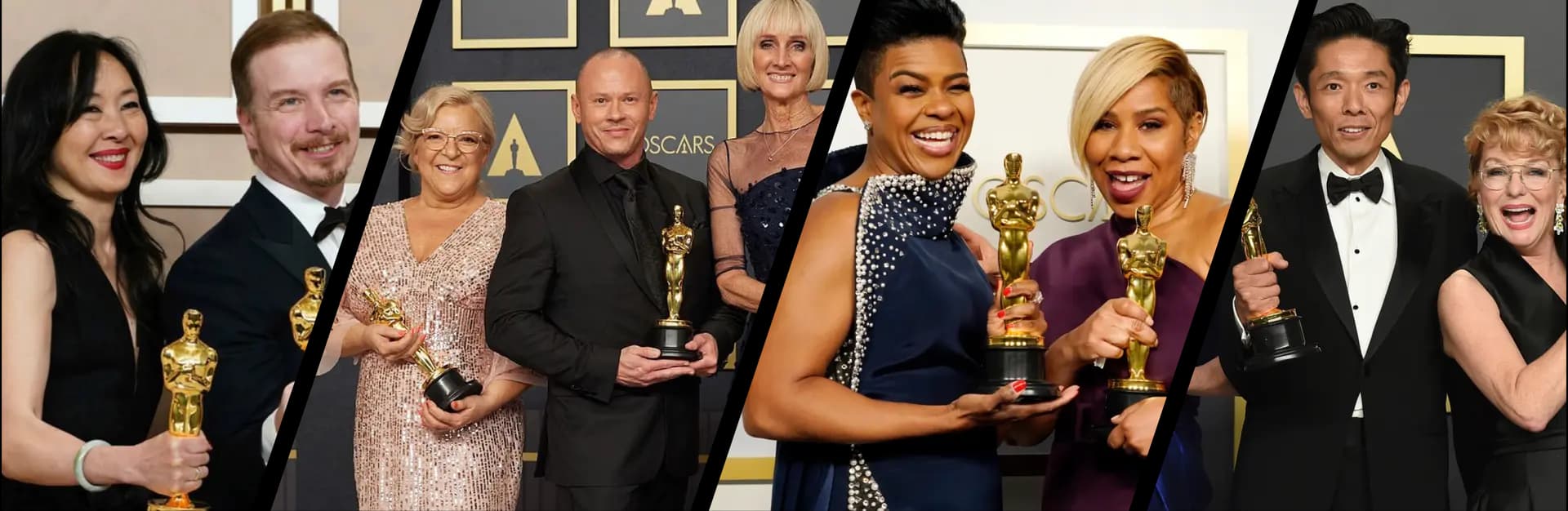
Photo depicts Oscar® winners from 2019-2023. Jordan Strauss; Michael Baker/AMPAS; Getty Images; Jordan Strauss/Invision/AP
Gender
Of the 328 nominees for Best Makeup and Hairstyling, 41% were women.* There were only 5 years of the 45 examined that had no women nominated in this category. The category was first awarded in 1982 and the first women were nominated and won in 1983 (Michèle Burke, Sarah Monzani). Forty percent of Oscar® winners in this category were women. A total of 5% of nominees were women of color, and seven women of color have won. The first woman of color was nominated and won in 1994 (Yolanda Toussieng).
Despite holding 41% of all nominations, women were still less likely to be nominated more than once compared to men. Eighty-two percent of women were nominated once while 71% of men received one nomination. There was also a difference among those who were the most nominated: the highest-nominated woman (Ve Neill) had 8 nominations versus the man with the most nominations (Rick Baker) had 11 nods.
Race & Ethnicity
Out of 328 nominees for Best Makeup & Hairstyling, 10% were from an underrepresented racial/ethnic group.* Just under half (16) of the 34 nominees were women of color. The first nominee in this category was named in 1990 (Ken Diaz). Eleven percent of the winners were underrepresented. 1994 was the first year an underrepresented nominee won the award (Yolanda Toussieng). In 24 of the 44 years the award has been presented, there were no underrepresented nominees. Notably, in 2007 half the nominees were underrepresented. Seventeen of the 28 nominees were Hispanic/Latino, 11 were Asian, and 6 were Black/African American.
There was no difference in the percentage of underrepresented (77%) and white (76%) nominees with one nomination. Underrepresented nominees had at most 6 nominations (Kazuo Hiro) while white nominees reached 11 (Rick Baker).